Cockaigne and the missing utopia, ep. 1

Simple desires beget simple utopias.
So, I’ve recently completed the AGI Strategy course by BlueDot (highly recommended, some of the best peeps lurking there), and some things picked at my mind…
First: will we be able to get to the said utopia at all, given the current pace of things (AI advancements, job market, strategic trends, etc)?
Second: given we reach it partly (post-scarcity society - basic needs provided for), how do we keep sane and goal-directed?
Now, the good news.
We’re really making it
The majority is living in the best version of a world, despite all the efforts. Yeah, yeah, the loneliness and obesity epidemics, and new viruses, and wars:

Majority is now fed (“The share of the world population that survives on fewer than 2,000 calories a day has dropped from 51% in 1965 to 3% in 2005”)
A larger share is connected to knowledge (“between 1994 and 2014, the number of people with Internet access worldwide leaped from 0.4% to 40.4%”, “66.7% in 2024”)

Majority has a passport/social security, a home with water (“More than 2.1 billion people finally got access to clean drinking water between 1990 and 2012”)
Most diseases are managed (e.g. polio, the plague, even HIV!)
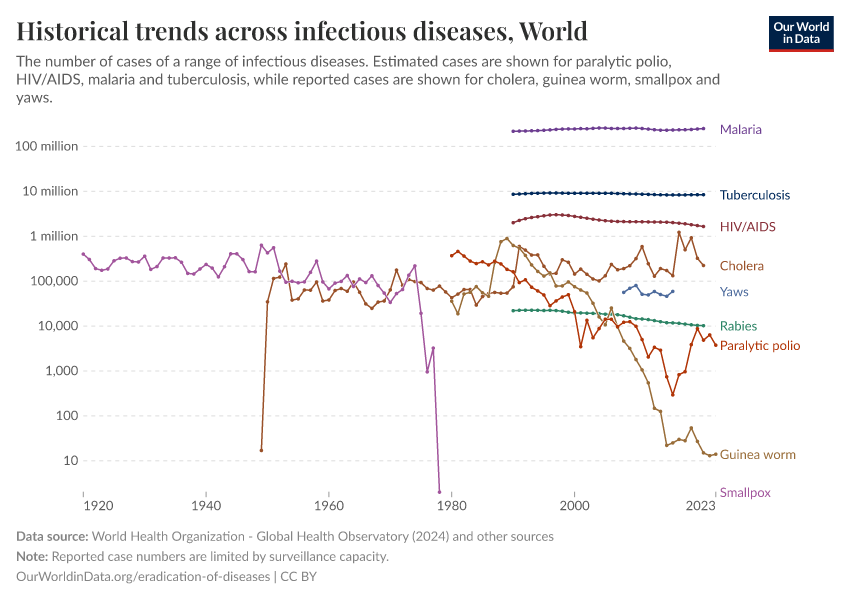
- Cancer, the disease that began its royal stroll, is being curbed with CAR-T, checkpoint inhibitors, etc.

Courtesy of my no-lifer research friend, Perplexity
Let’s not forget the more flashy advancements:
- Top LLMs are now extremely close to an extremely gifted uni grad and presumably capable of completing tasks of hour+

- For the list of other 2025’s achievements in science, let’s go to an awesome website:

Pretty awesome, to me. Frozen embryos, autonomous driving, 100% lethality viruses! AI, AGI, ASI promise to nitro-boost the progress - think flying embryos, autonomous viruses.
Is this enough? Are we reaching our own Cockaigne? While you wonder what’s that is…
What’s and Cockaigne/Cockayne?

Why was the land of plenty called Cockaigne in the Middle ages? Did they know something?!
…medieval peasant’s dream, offering relief from backbreaking labor and the daily struggle for meager food.
So, it seems materially/scientifically we’re heading there? But, if material progress is largely on track, the real bottleneck becomes meaning.
Yet…not THAT making it
The crisis of meaning

Yet, with all these, approaching post-scarcity (or are we?), there would be less reason to get up for most. Not what you’re thinking, pervs! Oh that’s me…
Consumption? Boring or deadly if overdone.
If a political party or a religious sect had even a fraction of the influence that the advertising industry has on us and our children, we’d be up in arms. But because it’s the market, we remain “neutral.” - R. Bregman “Utopia for realists”
Discovery? Getting harder, more expensive and more competitive, still. Gone are the days when one could just think of a negative number and be forever etched in history…
When all the diseases are taken care of, the food is plentiful and free, and there’s no need to work - what'd be left to do?
Bregman captures the incentive and meaning trap perfectly: eating cheap, calorie-dense garbage + work automation + overconsumption ➡️ therapy to mend the damage. That’s the dystopia we are already in, before any AGI-powered Cockaigne arrives.

Reminiscing about the lessons of rat paradise (Calhoun’s mice ‘behavioral sink’ experiments that highlight the social breakdown and societal collapse due to extreme overcrowding, even with ample resources), I’d reckon that meaning is crucial for humanity to thrive further. Should we all resort to logotherapy to find meaning? Will it work in a post-scarcity society?

Someone solving? Solved?
Are there countries/communities that task themselves with solving the “how should we live when everything sorts out, or how should we get to it” dilemma?
Any possible factors tied to non-work life satisfaction?
Factors
Some factors are working - on a small scale (100…a small city-sized communities):
faith and engagement in religious groups (e.g. Amish, or Seventh Day Adventists - 88% as ‘happy’ or ‘very happy’)
tight-knit social bonds (Social connectivity is generally found to be the most prominent predictor of happiness, and the participants scored relatively high on measures of social life.)
communal psychedelic use (e.g. UDV and Santo Daime churches) ➡️ higher reported well-being and social connectedness; the mental effects of tryptamines are robust enough to matter even after selection effects
purposeful, intentional living (e.g. Twin Oaks, Mondragon corporation - reported at 5.9-6.1/7 on main measures of life satisfaction). Some even have a population cap - Twin Oaks sits at ~100 (! We’re not designed for larger-than-Dunbar communities?).
So, yeah - it seems possible on a small scale. Is it possible on a larger scale, though?
Likely no at fully global scale (at least not yet); yes at many overlapping ~100-5,000 person ‘Cockaignes’ with good infrastructure.
However…if we direct our gaze about 10 mm downwards, to a wealth-adjusted life satisfaction chart and table by Greater Goods’s Mohsen Joshanloo:

And clustered:

Mohsen adds the following factors as important, as per his research:
perceived job quality (satisfaction with the psychological aspects of work, including autonomy and engagement);
a sense of freedom to make decisions;
experiences of enjoyment;
social capital (including volunteering, helping others, and opportunities to form new friendships).
So, something seems to overlap (intention, freedom, social bonds)?
Common thread regardless of scale is not vibed yet engineered: small groups, a narrative people can relate, intentional living, rituals, clear expectations and a sense of contribution (and dropping psychedelics together!). Without it, we’ll just sit in a dissociation chamber of abundance.
Afterthoughts and hooks
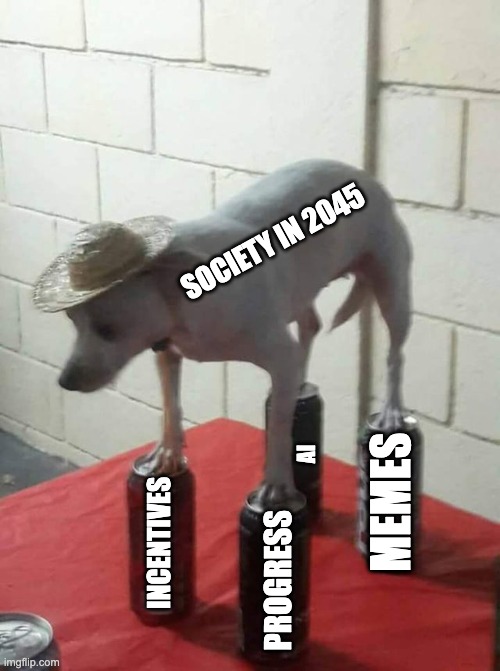
This was just the meaning problem. Are there other barriers we will face or are already facing?
There’s a second one furiously brewing in the background: once any agent can flood the world with plausible words and images, how do we even tell whether our land of plenty is real or just a very pretty lie?
Another perspective: tasks automated, layoffs imminent, slow socioeconomic collapse and disempowerment where individual contributions shrink (disempowerment scenario - explained here). Crisis of truth and power is just as dangerous as to crisis of meaning.

More in that in the next episode, Brandolini’s law: is there a clear path to CockAGIne? (I’m coining this term lest the idea vultures come… Choo, choo, leave!).
In the meantime, if you’re OK with being proactive - some smart peeps had already made marketplaces to find things to contribute ❣️
Welcome to Teleogenic❣️
Other places I cross-post (not always) to:


